
As described previously my experiments with the ‘Home Grown Indoor Garden’ has curried my interest in trying some different types of grow lights in different situations. My lovely wife presented various grow lights to me for Father’s Day, and I have been fooling around with some of them ever since.
The Grow Lights
These new grow lights might be described as ‘halo lights’, being a round halo (or donut) shaped grow light, screwed onto an extendable telescoping stainless steel tube (extendable between 30cm and 120cm) that is pushed into the soil near the plants you want to grow. The plug is USB, great if you are running it off a computer or other USB port, but if one isn’t available you need to get a 240v adapter to power it from a standard wall socket. It does have automatic timing for 3hrs, 9hrs or 12hrs, depending on how many times you push the button. Of course, if you are running the off your computer, when the computer shuts down so do the lights.
Unfortunately, only three out of the four lights were operational when I was given them, and the 'send back' time had expired so I just had to wear it. I don't know if a 25% failure rate is common, but the lesson is obvious, check them as soon as you receive them, even if you don't intend on installing them right away.
.jpg)
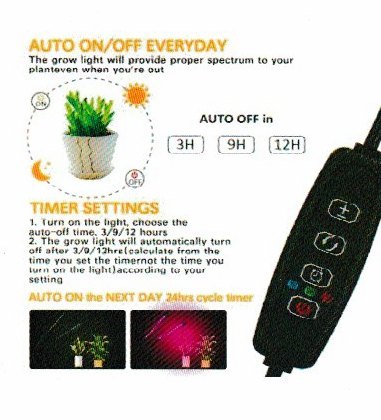
Important: if you do try these grow lights, ensure that you 'read the user guide befor keep it ptoperly'
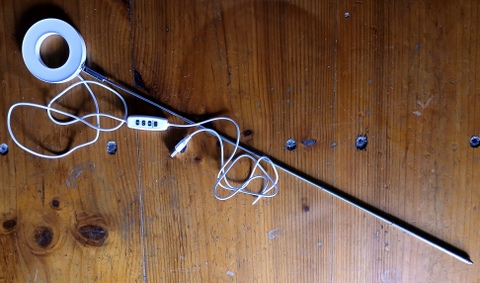
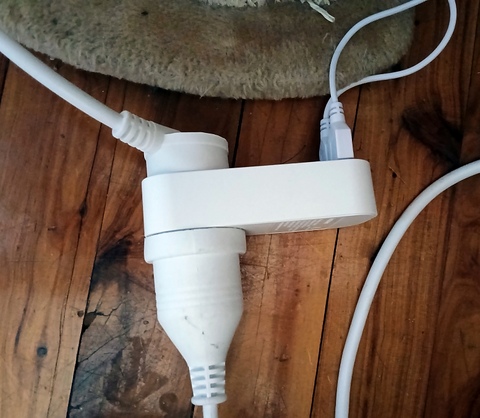
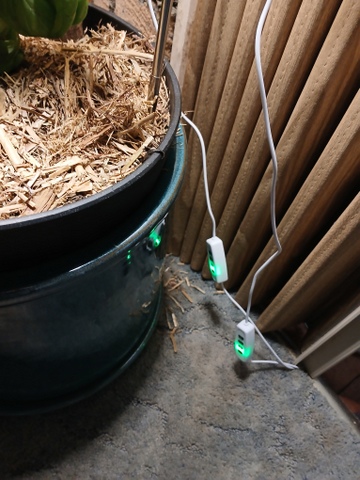
My connection set up
First Iteration
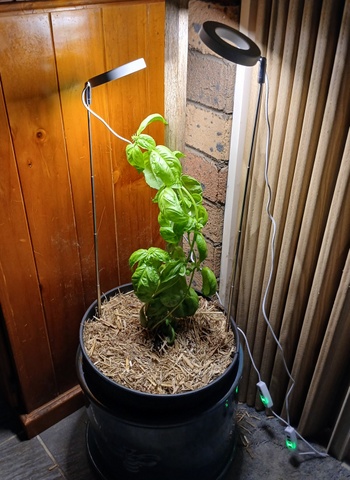
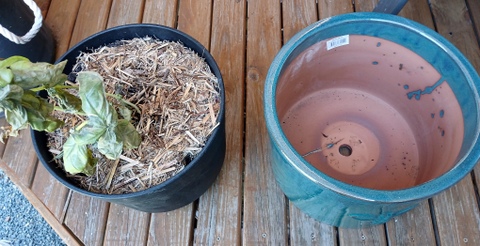
I wanted to get a nice, fairly large terra cotta pot for a dark place near the front door, and what we got was a 255mm deep by 325mm wide glazed terracotta pot, and we also got a pot saucer to go underneath it, and basil plants to go in it. The problem was, while it was set up mostly on floor tiles, it was close to an area of carpet and floorboards, and any overflow due to drainage from the pot would cause problems. To get around this I got hold of a plastic pot that fitted inside the terra cotta one and which had an area in the bottom for the water to drain into but no drainage external to the pot, a so-called self-watering pot.
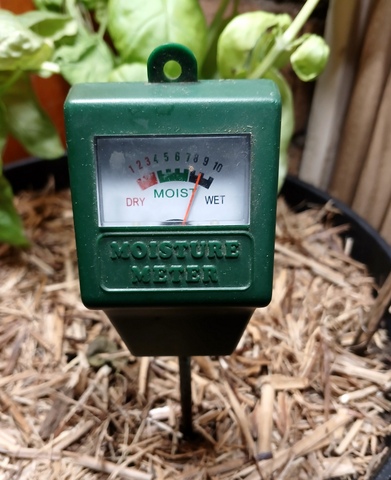
I set it up with two halo lights, one each side, connected to a two socket 240v adaptor, with a nice crop of basil plants. I set it up towards the end of September (2025) and it worked well and provided us with basil leaves for pizza and pasta for about 8 to 10 weeks, but then it started to look rather poorly. Judicious application of my El Cheapo moisture meter confirmed what I have suspected, the water had backed up past where the basil plant was comfortable and it now had wet feet. I had figured (hoped) that small amounts of added water would make up for losses due to evaporation and transpiration. Clearly this was not the case.
Still, that is why I call these experiments, and while all of them are educative, not every experiment is a success.
Second Iteration
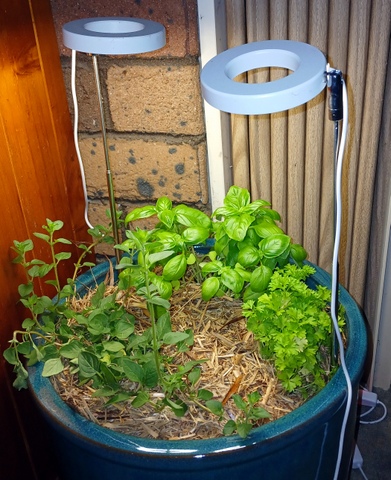
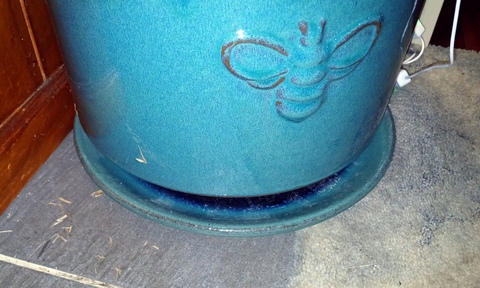
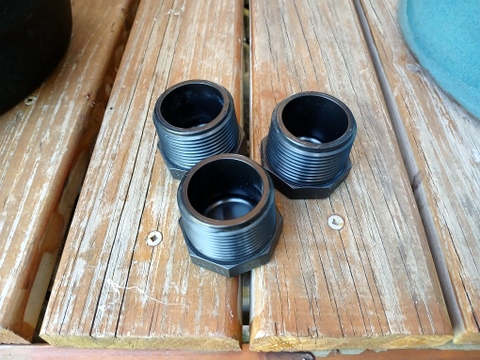
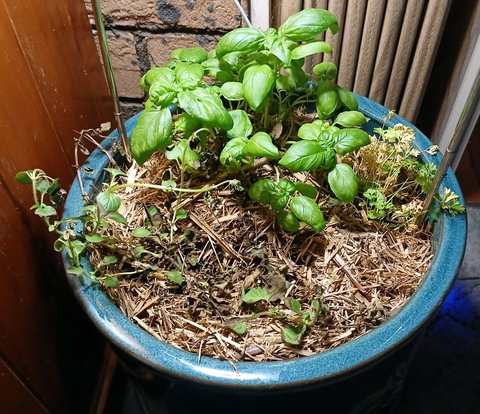
So, I decided to change things around. I removed the plastic inner pot, placed a broken terra cotta pot shard over the hole in the outer pot to ensure drainage and then filled it with potting mix and then planted it with basil, parsley and oregano plants. To ensure that the pot could drain, and so I could judge the level of the drainage water in the pot saucer, I used some irrigation plugs that I had hanging around to go between the pot and the saucer. I had seen a similar idea on the net using plastic soft drink bottle tops, but we don’t drink much in the way of soft drink these days and I already had the plugs. Before bringing it inside and setting it up in the corner I gave it a good water and left it outside to drain. The moisture meter is telling me we are currently at the top of the ‘moist’ range, so we are ready to go!
That did seem to fix the water problem. However, while the basil prospered, the parsley and oregano were clearly not happy and eventually faded away. It occurred to me that having two ‘Halo lights’ may have been a bit much.
Third Iteration
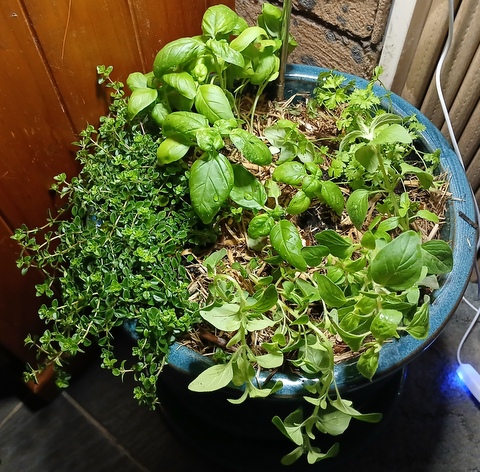
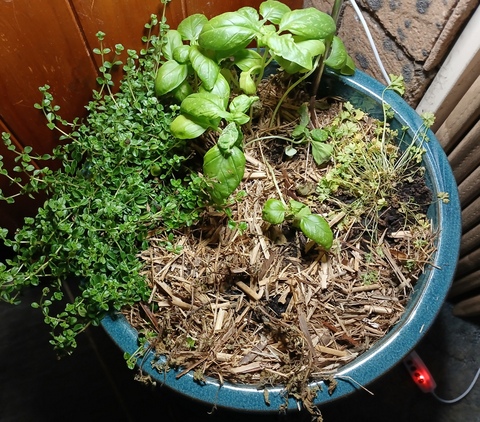
I redid things, again! I replaced the parsley and oregano, added in some pizza thyme, and I was concerned that maybe the two halo lights were providing more light than the oregano and parsley could enjoy so I removed one of the lights, moved the remaining one closer so that the PPFD (Photosynthetic Photon Flux Density) provided by the light was 140-150 μmol/(m²·s). During this time both the basil and thyme plants were doing OK.
Fourth iteration
Within a couple of weeks, the parsley and oregano had again passed on to the herb garden in the sky, so much for that idea! The problem is obviously not water buildup or too much light. However, the thyme is still thriving and so is the basil, so I needed another rethink. I removed to corpses of the herbs that were no longer with us and instead substituted a sage and rosemary plant to see how they coped with the system.
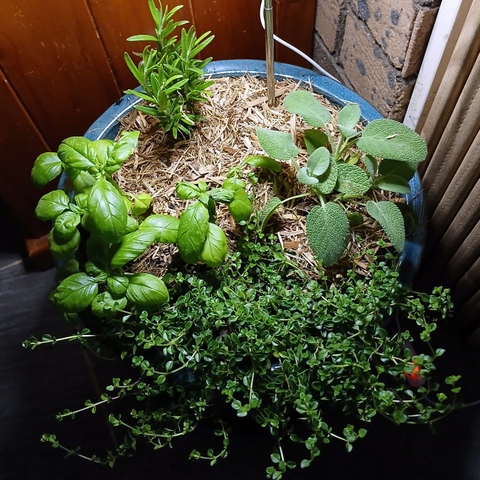
It has been a week and all the herbs in the garden seem to be doing well, I may have hit on the right combination!
The journey continues!