The term ‘The Good Life’ has, over the years, become a synonym for a life of self-reliance and/or self sufficiency, either in the suburbs or in the bush and has been used as a title for several books and even a British sitcom from back in the mid to late ‘70s. Why even I myself have used it for the title of two articles printed in Grass Roots Magazine: Achieving the Good Life (1989) and The Good Life Revisited (2024).
As with previous articles dealing with ‘The Library’ the books I refer to are from my personal library and so it may be that there are others entitled as or referring to ‘The Good Life’ but the ones included below are the ones we have on hand in our own personal library. Feel free to point out any I have missed!
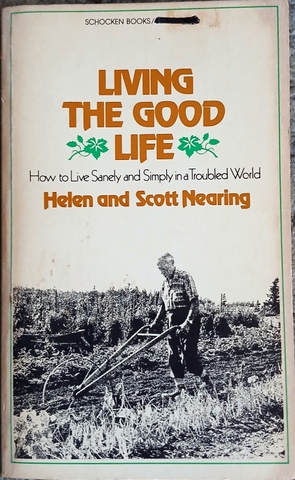
Living the Good Life – Helen and Scott Nearing – Schocken Books (US) 1954 (original) 1970 (my copy) ISBN 0 8052 0300 1 – As far as I am aware, this is where things all began. The book is in standard paperback format and has over 200 pages, it is broken up into eight chapters. Chapter one, We Search for the Good Life, and talks about how they became disillusioned with the western lifestyle and wanted something more rural, which they found in Vermont. Chapter two covers how they designed their self sufficient house, chapter three covers how they built it and chapter four covers how they set up their land to be productive. Chapter five talks about how modern food and food products are ‘poisoned’ and how they produced their own organically, chapter six covers how they set themselves up to make the most out of the money they had and avoided debt, Chapter seven talks about the community that they became a part of. Chapter Eight talks about the pros and cons of the approach that they took. The book has no illustrations.
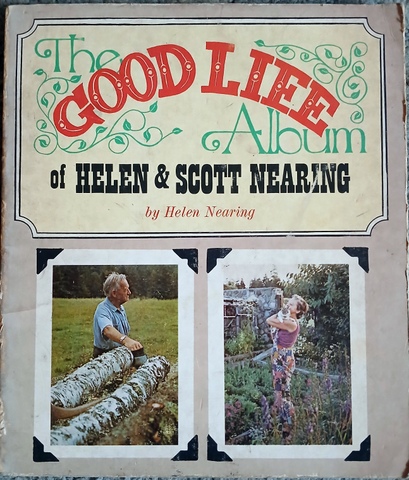
The Good Life Album of Helen & Scott Nearing – Helen Nearing – Sunrise Books/E.P. Dutton & Co Inc. (US) 1974 ISBN 0 87690 144 5 – While the book above (Living the Good Life) is all text with no illustrations, this one has a small amount of text and is mostly illustrations in the form of almost 200 black and white photographs. The book has an introduction written by Helen, summarising their lives separately and together (it seems she spent several years in the 1920s in a commune on Sydney harbour!) followed by six chapters composed of collections of B&W photos. The first chapter, entitled ‘Maine’ that covers how they set up their house and tilled the land in their ‘Forest Farm’ in Maine’, the second chapter, entitled ‘Vermont’ records their life on their property there. Chapter three ‘Out in the World” records their travels to places such as Kyoto, Japan; Baku in the USSR, Bombay and Delhi in India and Stockholm, Sweden. Chapter four is a collection of photos of Scott’s younger days and Chapter five is a collection of similar photos of Helen’s younger days. The final chapter is a collection of photos of both of them as children.
There are other books in the vein of Living the Good Life by the Nearings which are not in my library, they include: Continuing the Good Life (1979); Simple Food for the Good Life (1980); Loving and Leaving the Good Life (1992), and Wise Words for the Good Life (1999).
The Good Life – Mary Moody – Lansdowne Press (AUS) 1983 ISBN 0 7018 1512 4 – The book is divided up into nine chapters, chapter one, The Possibilities, acts as an introduction and gives some family history for the author and her thoughts about living more self sufficiently and how they were able to do it. Chapter two, The Property, describes how to select and finance a property as well as decisions on the size of land, water availability, fencing and provides a checklist before deciding, then goes into details on how to build or renovate a house. Chapter three, The Services, talks about water collection and storage, heating with wood, lighting and electricity. Chapter four, The Garden, discusses starting out with a veggie garden, tools, growing from seed, planting systems, irrigation systems and pest and disease control. Chapter five, The Crops, talks about growing and harvesting vegetables, herbs, spices, fruits and nut trees. Chapter six, The Livestock, mainly talks about chicken keeping but also talks about other birds, and farm animals and a house cow. Chapter seven, The Kitchen, discusses food storage and preserving, sprouting, fermenting, making dairy products and bread. Chapter eight, The Crafts, talks about sewing, knitting, crotchet, clothing repairs, spinning, dyeing, felting and simple pottery. Chapter nine, Family Health, talks about nutritional needs, vitamins and minerals, ‘natural’ cures and alternative medicine and herbal cosmetics. The book has lots of illustrations mainly line drawings with some B&W and colour photos.
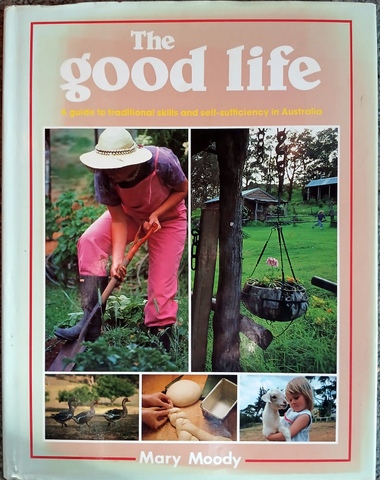
The Good Life in the ‘90s – Mary Moody – Simon & Schuster (AUS) 1995 ISBN 0 7318 0466 X – This is (obviously) a reviewed and updated, and in some cases condensed, version of the book above. Chapter one, The Philosophy talks more about community and large scale actions on environmental issues, Chapter two, On the Homefront, rather than being about building or renovating a homestead is more about making an existing dwelling more efficient and sustainable. Chapter three, Creating and Maintain the Garden, is basically what it says on the tin, but also mentions organic gardening, permaculture and Seed Savers and covers most subjects about starting a new garden, but also bushfire regeneration. Chapter four, five and six discuss what vegetables, herbs and fruit trees to grow in the garden respectively. Chapter seven, Creatures Great and Small, covers chooks, cats and dogs and supporting biodiversity in the garden. Chapter Eight, The Kitchen, covers similar subjects as the previous book but in reduced detail. Chapter Nine, The Crafts, covers sewing, clothing repair, knitting and crochet, patchwork, furniture repair and stencilling. Chapter ten, Family Health, covers similar subjects to the above but in reduced detail. To me, this book is much more ‘modern’ for want of a better term and is more focussed on information that can be of use in the suburbs as well as the bush. Illustrations are restricted to line drawings.
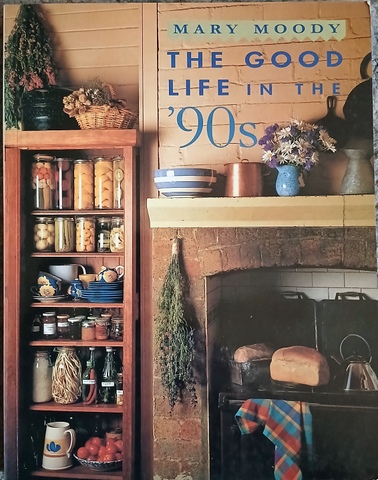
Living the Good Life – Linda Cockburn – Hardie Grant Books (AUS) 2006 ISBN 1 74066 312 8 – I can’t believe it has been 20 years since this book was released! It is set out in seven chapters, the first six being January to June and the final one being ‘The Results’, it is an easy book to read cover to cover. Each of the month-by-month chapters is set up by date and documents the author and her family’s working towards living self sufficiently and sustainably on a suburban house block in Brisbane and without spending anything for six months with exceptions like rates, taxes, insurance and medical bills. Each chapter, as well as the main narrative, contains recipes and side notes on various subjects such as permaculture, the waste reduction, global warming, household water use (including how to measure it) and salinity, which are referred to in the narrative around how they are dealing with these subjects. The last chapter, Results’, is a series of reports on how they did over the six months including power, water, waste, transport, health and finances. It is a fascinating and inspiring book, well worth reading! The book has a several line drawings and a section of ten colour photos near the centre of the book. Note: They have recently released a 20 year anniversary edition of the book as Living the Good Life: Revamped.
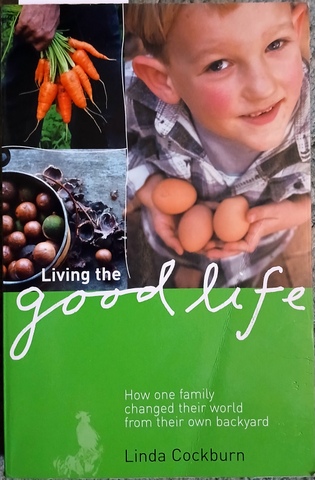
The Good Life – Hannah Moloney – Affirm Press (AUS) 2021 ISBN 978 1 922419 38 5 – After an introduction, the book is divided up into six chapters, followed by sections on further reading, acknowledgements and sources. In the introduction she talks about how and why she became an environmental activist growing up. Chapter one, Our Good Life, talks about how she met her husband and their shared values and she also introduces a space for the reader to explore their own values. Chapter two, Our House, talks about how she bought and they renovated the house, but also how to renovate for sustainability in more general terms, there is also a section to brainstorm what you can do to make your house more sustainable, and a number of case studies on what others have done with their homes. Chapter three, Our Garden, covers how they designed their block to be more productive and then implemented their design. This is followed by more general information on subjects such as soil preparation, box gardens, feeding your soil and seed raising followed by garden and small farm case studies. Chapter Four, Our Food, talks about the authors relationship with food and then provides recipes and processes for producing food waste free, such as soft cheese, yoghurt, veggie stock from scraps, croutons, kimchi, salsa and rustic pie. Various styles of composting an treating organic waste are also covered. Chapter Five, Our Community, The author talks about supporting first nations people, their food share stand, ride sharing and then provides space for the reader to work out what they can do to build community, and then provides information on community building initiatives already operating. The book has a huge number of colour photographs and some line drawings.
Note: Hannah has also released a new book in 2023 called 'Good Life Growing'.
DVDs
I thought that it would be remiss of me to finish the article without mentioning the BBC comedy series of the seventies, especially since we do have the DVDs of the series in our collection!
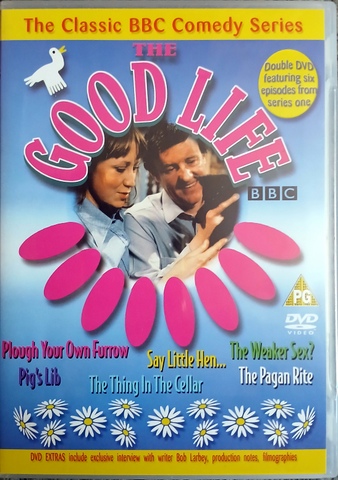
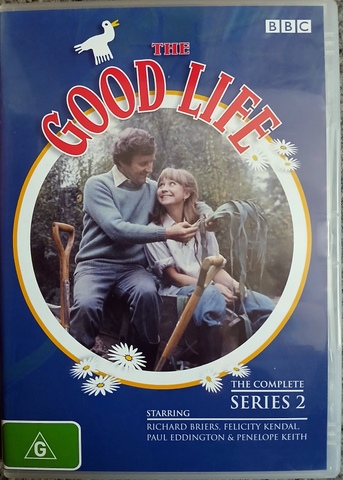
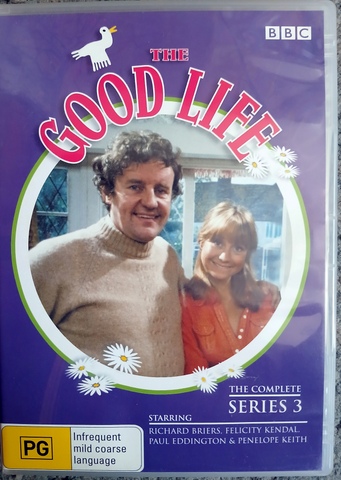
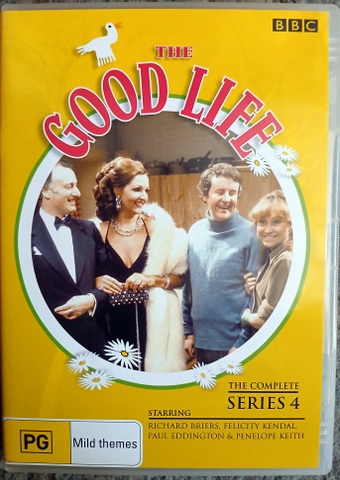
The Good Life
The series starred Felicity Kendall (as Barbara Good) and Richard Briers (as Tom Good) as the couple at the centre of the series and Penelope Keith (as Margo Leadbetter) and Paul Eddington (As Jerry Leadbetter), their neighbours. On turning forty, Tom Good decides to give up the job he has become disillusioned with and go self sufficient on their suburban block in Surbiton, a suburb of South-West London. There were four series, the first one having six episodes and the remaining three consisting of seven episodes each.
I could not summarise the series better than this paragraph from the Wikipedia entry –
“On his 40th birthday, Tom Good is no longer able to take his job seriously and gives up work as a draughtsman for a company that makes plastic toys for breakfast cereal packets. With their house in The Avenue, Surbiton, paid for, he and his wife Barbara adopt a sustainable, simple and nearly self-sufficient lifestyle while staying in their house. They turn their front and back gardens into allotments, growing soft fruit and vegetables. They introduce chickens, pigs (Pinky and Perky), a goat (Geraldine) and a cockerel (Lenin). They generate their own electricity with methane from animal waste, and attempt to make their own clothes. They sell or barter surplus crops for essentials they cannot make themselves. They cut their monetary requirements to the minimum, with varying success.”
Bonus Content
While this does not overtly refer to ‘The Good Life’ it is sort of like the Welsh equivalent.
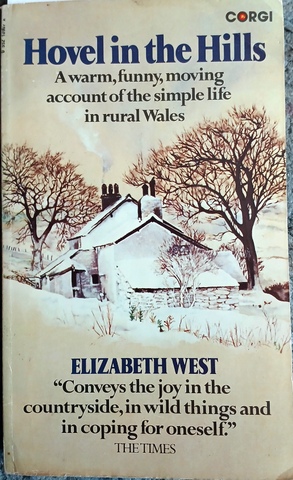
Hovel in the Hills – Elizabeth West – Corgi Books (UK) 1977 ISBN 0 552 10907 X – This is the account of the life that the author and her husband lead from 1965 to 1974 in their hovel ‘Haphod’ in the north Wales countryside. The book has a foreword by John Seymour! It talks about them leaving the city and eventually committing to a small stone house with some outbuildings and land, and how they renovate the house, attempt to grow food and make a life in wilds. The book has no illustrations.