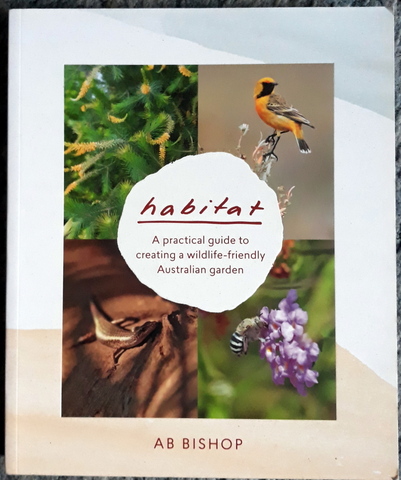
Habitat – A.B. Bishop – Murdoch Books Australia (AUS) 2018 ISBN 978 1 76052 347 3 – The book has ten chapters in two parts, each chapter has a case study at the end illustrating how the chapter can be used in practice. Part one (Biodiversity for Life) has three chapters, chapter one details what a habitat garden is and why it is beneficial; Chapter two covers ecology and food chains/webs; chapter three discusses how food webs work in the backyard. Part Two (Backyard Habitat) starts with chapter four which talks about plants for your backyard habitat, including classes of plants such as those for food, shelter and socialising and plants for pollinators. At the end of chapter four is an extensive plant directory with photos giving data on what layer and (Aust) zone they are for, flower colour, what they contribute and how high they grow. Chapter five covers earthworms and insects and how to put in habitat to support them; chapter six does a similar thing for frogs and reptiles; with a section at the end covering pests and other undesirable visitors. Chapter seven talks about habitat to support bird life; chapter eight does a similar thing for animals such as bats, possums and gliders; Chapter nine covers hints and principles for designing habitat garden and chapter ten gives details for projects to improve the biodiversity in your area such as constructing bee/bug hotels, bat and other animal boxes and a frog pond. This is a wonderful book, with lots of colour photos!
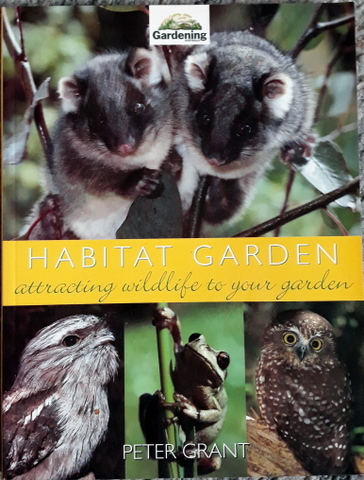
Habitat Garden – Peter Grant – ABC Books (AUS) 2008 ISBN 978 0 7333 1279 3 – This is a great book, lots of info! Chapter one covers the what and why habitat gardening chapter two talks about planning the habitat gardening, why do it, the planning process and includes some garden scenarios. Chapter three talks about propagating plants for the habitat garden; chapter four covers the activities associated with maintaining it including watering, mulching, pruning and managing weeds and pests. Chapter five covers attracting birds, insects and animals to the habitat garden, chapter six covers putting in a habitat garden in difficult areas such as coastal, rainforest and arid gardens. Chapter seven provides details on groups, nurseries and environmental care groups from plants and information can be available. Lots of colour photos.
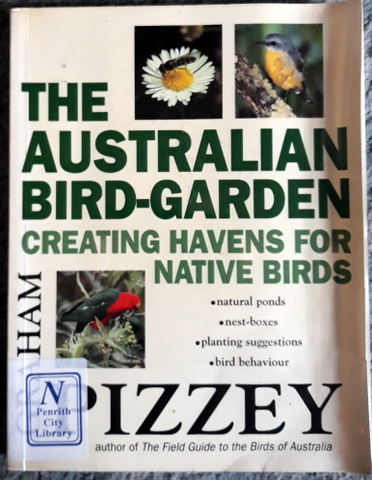
The Australian Bird Garden – Graham Pizzey – Angus & Robertson (AUS) 2000 ISBN 978 0 207 19675 3 – The book is written in four parts. Part one covers experiences from the author’s garden and travels. Part two covers the practicalities of setting up a bird-garden including what native birds need, soil, water and feeding birds, when birds fight their own reflections and nesting boxes. Part three discusses a few bird species and their behaviour, then more general information about birds as pollinators. Part four talks about plants and how they grow and interface with insects and birds. There is an appendix of plant lists by capital city with some smaller cities included. The book has lots of colour photos.
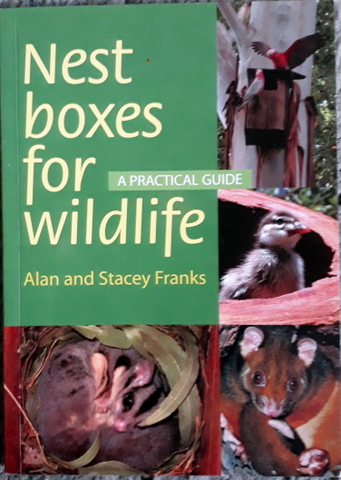
Nest Boxes for Wildlife – Alan and Stacey Franks – Blooming Books (AUS) 2006 ISBN 978 1 87647 20 7 – This small book starts by explaining why providing wildlife nest boxes is important in chapter one. Chapter two talks about the animals covered in the book and some of their habits. The main part of the book provides detailed plans, material and tool lists and instructions on how to build and mount animal nest boxes. The plans cover boxes for 17 bird species and 11 mammals. Chapter five covers providing food and water as an attractant to use the nesting boxes. The book features line drawings and lots of colour photos.
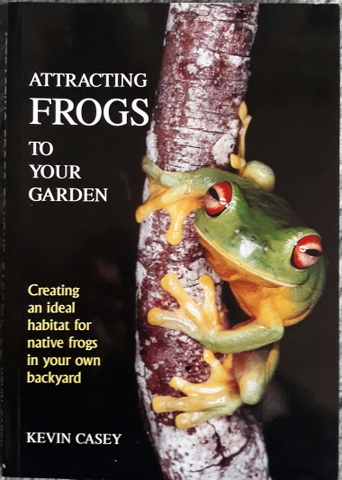
Attracting Frogs to Your Garden – Kevin Casey – Kimberley Publications (AUS) 1996 ISBN 978 0 9587628 0 5 – Again, this is a small book. But with lots of info. Chapter one talks about why there has been a decline in frog numbers and provides some hints for attracting frogs to your garden. Chapter two gives a general review of our unique amphibians, chapter three suggests some resources to assist with frog identification and details simple steps to be taken that improve frog identification. Chapter four talks about how to look for frogs and chapter five talks about frogs as pest controllers. Chapter six covers cane toad identification and eradication. Chapter seven talks about frog calls and mating while chapter eight talks about doing the right things to keep frogs happy and healthy and chapter nine talks about raising tadpoles. Chapter ten details hot to set up a backyard frog pond and chapter eleven goes through ‘frogsaping’ your backyard with the appropriate frog-friendly plants. Chapter twelve covers attracting other animals (native birds, mammals, insects etc) and chapter thirteen covers frog photography. The book has line drawings, lots of B&W photos and a couple of colour photos on the covers.
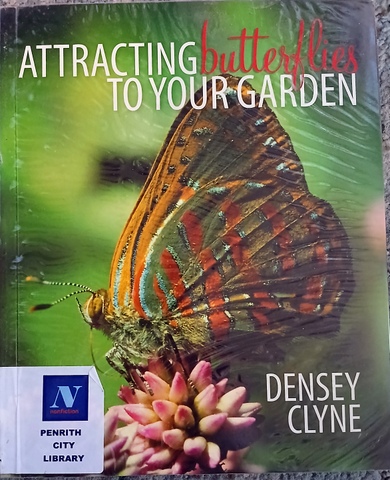
Attracting Butterflies to Your Garden – Densey Clyne – Reed New Holland (AUS) 2011 ISBN 978 1 87706 984 0 – The introduction of this book makes the point that if you want to attract butterflies to your garden you have ‘two mouths to feed’ ie caterpillars as well as butterflies and each has different needs. It also talks about the possibility of rearing butterflies indoors. This is followed by the main part of the book which is broken up into five sections, each section dealing with a butterfly family: swallowtails; nymphs, browns and danaids; whites and yellows; blues and coppers; skippers. Each chapter lists the number of butterflies in the family (seven, eleven, seven, five and two respectively) and provides a monograph for each. Each monograph provides the common and Latin name, an introductory paragraph describing the butterfly and giving some other details about it, a list of the arval food plants, a description of the butterfly stages such as egg, larva, pupa and adult, a photo of each stage (mostly) and a map of Australia showing their range. At the end of the book there is a list of plants alphabetically and the butterfly(ies) that feed on each one. The book has lots of colour photos.
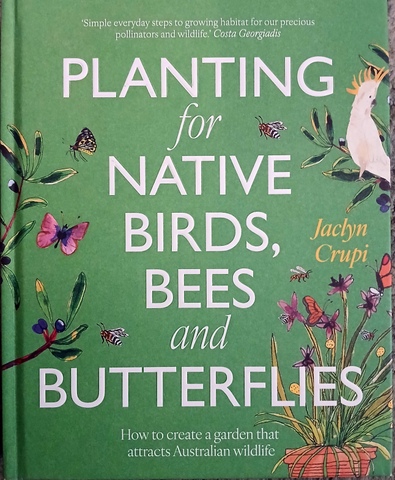
Planting for Native Birds, Bees and Butterflies – Jaclyn Crupi – Murdoch Books (AUS) 2025 ISBN 978 1 76150 046 6 – This book is rooted in permaculture principles (Hannah Moloney’s to be precise – see page 198!) and is extremely practical in its approach. The book is broken up into an introduction followed by three sections. The introduction talks about the problem of wildlife decline and what we can do in terms of habitat elements, inhabitants, how to help local wildlife without planting anything and asks if req=wilding is the answer. Section one (Essential Elements) starts out with looking at your garden and what is already present, how to plant and identifying wildlife in your area. Section two (Wonderful Wildlife) subsections on planting for birds, bees, butterflies, lizards and frog ponds. Section three (Practical Points) talks about planning, organic gardening, biodiversity on verges, balconies and rooftops and activities to support biodiversity beyond your backyard. Each section has articles by experts in the area eg Hannah Moloney’s article on applicable permaculture principles. The book has lots of colour illustrations and photos.
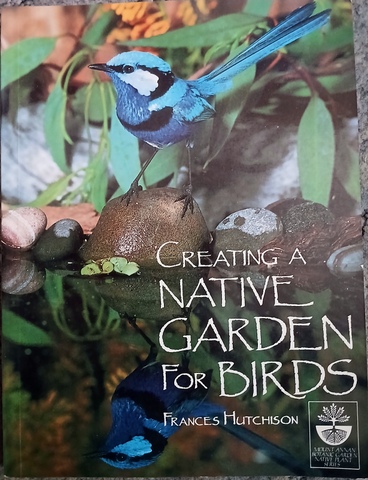
Creating a Native Garden for Birds – Frances Hutchison – Simon & Schuster (AUS) 1990 ISBN 978 0 7318 0133 4 – This is the first book of the ‘Mount Annan Botanic Garden Native Plant’ series. After an introduction about the Mount Annan Botanic Garden, the book is broken up into ten chapters. The first chapter (The Natural Garden) covers setting up your garden including general comments on what birds need in a garden, soils, plants, how ot plant and the water supply. Chapter two to six discuss various plants and how to integrate them into your bird friendly garden including open areas and low plants; basic shrubs; thickets, shelter and underplanting; vines and trees. Chapter seven provides a bird reference section providing information on feed, habitat and nests for twenty five common Australian birds. Chapter eight covers how human contact can be managed including food and feeders, nesting sites and boxes including some DIY ideas. Chapter nine talks about predators such as cats the effects of toxic pesticides and how they can be managed. Chapter ten covers community planting to attract birds. This is followed by an appendix with general bird information including first aid for birds and various organisation that can provide information on native birds. The book has some line drawings and colour photos.
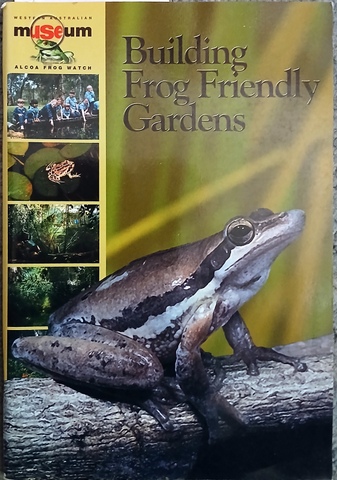
Building Frog Friendly Gardens – Ken Aplin, Anthea Paino & Lyndal Sleep – Western Australian Museum (AUS) 2002 ISBN 0 7307 5782 X – This is a small booklet of 67 pages produced in association with Alcoa. The booklet has eight chapters, the first being an introduction and talks about four steps to get a frog back into your life. Chapter two, a frog’s eye view of the world, talks about what frogs need in general terms, but also describes the frog fungus disease. Chapter three, meet your local frogstars, provides photos, descriptions and information on their calls for ten local (in WA) frogs, and chapter four covers planning your frog habitat including shelters and control of predators. Chapter five talks about creating a frog pond, chapter six covers brining the pond to life using plants, insects and other invertebrates and fish. Chapter seven talks about the requirements for breeding frogs in your environment and chapter eight (one page) suggests ways to share what you have learned in the process. The booklet has a number of line drawings and B&W photos.
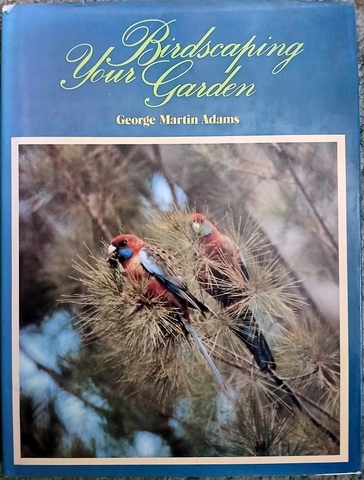
Birdscaping Your Garden – George Adams – Weldon Publishing (AUS) 1980 ISBN 0 947116 93 1 – After a short (1 page) introduction, the book has six chapters, with chapter one provides an introduction to Australian bird species under the headings of honeyeaters; parrots lorikeets and cockatoos; finches; wrens; pigeons and doves. Chapter two talks about bird habits and behaviours including requirements for food, water, nesting and shelter, with chapter three provides hints on creating sanctuaries for native birds and includes several plant lists, making a waterer and feeder and various types of nest boxes. Chapter four discusses growing Australian plants, by buying them in, grow from seed and growing from cuttings; chapter five is about birds in the service of plants by pollinating, seed dispersal and insect control. Chapter six takes up over half the book and talks about specific plants that are important to birds, listing 181 plants alphabetically by their Latin name with each entry providing common name, plant distribution, birds they attract, a description of the plant and how they are cultivated. The book has several sections of colour plates showing birds and the plants as well as some B&W photos and line drawings.
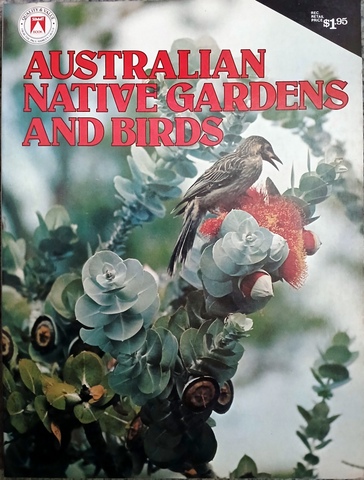
Australian Native Gardens and Birds – Barbara Salter – Ure Smith (AUS) 1977 ISBN 0 7254 0372 1 – While being about A4 in format it is only 80 pages ling with nine short chapters most being around ten pages each or less. While the book does have some good information, the majority of the space is taken up with B&W photos. It is part of the ‘Summit’ series detailing information on plants for Aussie backyards. Chapter one is an intro to native bird gardens, chapter two talks about growing native plants, chapter three discusses how to attract birds to your garden and chapter four talks about some native animals you are likely to see in your garden. Chapter five gives some information on native trees and shrubs that can be included in your garden, chapter six talks about poisons in the garden and why not to use them, chapter seven provides information on some common native birds seen in the garden and chapter eight describes a ‘Day in the Garden’ and what birds might be seen. Chapter nine provides a page on conservation and native gardens. As mentioned previously, the book has lots of B&W photos.
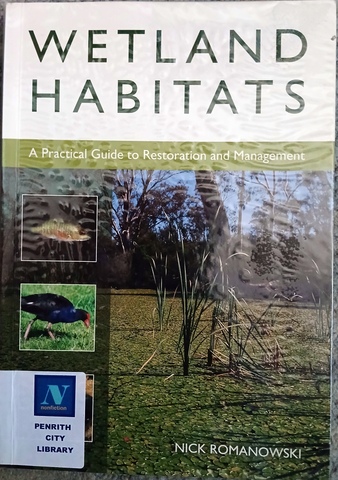
Wetland Habitats – Nick Romanowski – CSIRO Publishing (AUS) 2010 ISBN 978 0 643 09646 2 – While this is a manual for wetland restoration and conservation of animal species on the larger scale, it also has good information for smaller projects also. The book is divided into four parts, Part A provides basic information on what a habitat is and how they change over time. Part B discusses the impact of non-native species on wetlands including humans, weeds and animals while Part C talks about methods that can be used to repair wetlands such as techniques for management and restoration of the wetland, controlling populations, genetics and created dams and wetlands. Part D Provides details on plants and animals including invertebrates like crustaceans, insects. molluscs and worms, fish, amphibians and reptiles, birds and mammals and how they fit into the wetland habitat. Between Part B and Part C there are a series of thirty two colour plates illustrating animals, plants and various wetland habitats, there are no other illustrations.
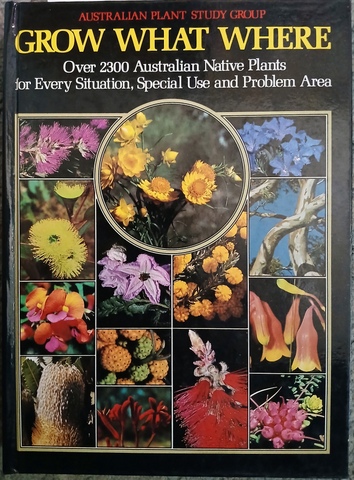
Grow What Where – Australian Plant Study Group – Thomas Nelson (AUS) 1980 ISBN 0 17 005798 4 – This is an amazing book with entries for over 2300 Australian native plants and where they can fit in to a garden or habitat. It is essentially a book of lists of plants based around particular attributes, such as flower colour, which soil they do best in and effect on the soil, types of foliage, where they can be used and how they are propagated. There is also a small section on plants that attract birds (for honey-eaters, for insect eaters and for seed eaters) as well as a section on butterfly attracting plants. There is even a section on food trees for koalas! The book has some line drawings and lots of B&W photos.