Design from Patterns to Details: “Can’t see the wood for the trees”. Start with observing natural patterns and then apply those patterns to your design.
In the words of David Holmgren in Permaculture Principles and Pathways Beyond Sustainability: “The first six principles tend to consider systems from the bottom-up perspective of elements, organisms and individuals. The second six principles tend to emphasise the top-down perspectives of the patterns and relationships that tend to emerge by system self-organisation and co-evolution.”
One of the classic illustrations of this principle is the spiral shape used when constructing a herb spiral. On the day that PSW were doing a blitz at our place many years ago, the main thing that I wanted was a herb spiral. While we were standing around discussing the design, a friend of mine who was a roofer, turned up with some waste rooftiles that we could use to construct it. Initially this was a great thing and I was grateful, but as we moved forward in the construction it became apparent that the tiles did not work well to make a spiral. So, rather than go back to scratch and ditch the tiles, we came up with a design of several concentric circles, and thus our ‘herb spiral’ became a herb wedding cake!
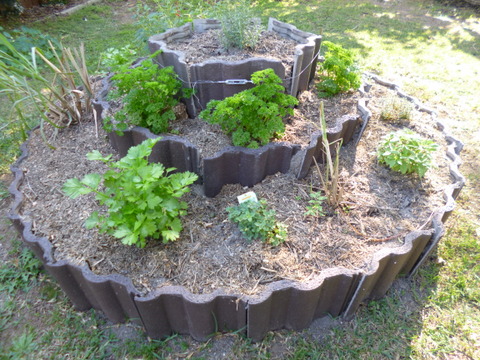
The herb wedding cake
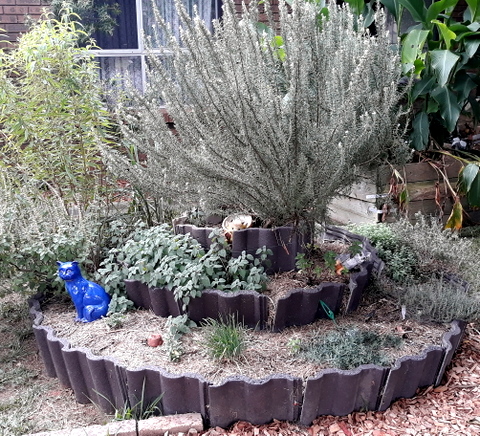
We have also used concentric circles in other areas such as the productive tree circle in the front yard that combines apples, citrus, nuts and a curry leaf tree and is set around a worm tower in the centre with an insect watering station on the top of the worm tower.
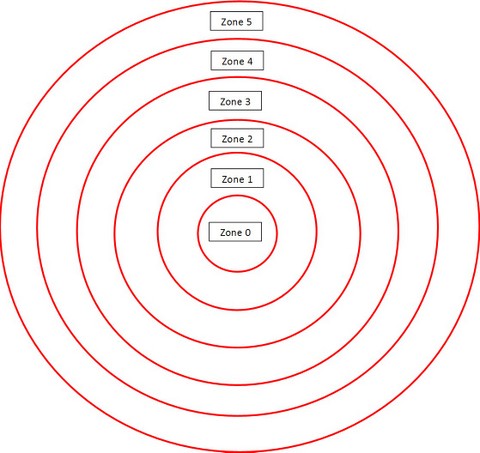
Another pattern generally portrayed as a series of concentric circles is the permaculture zone tool, which allows areas of similar use, activities and frequency of visitation to be grouped together when developing a permaculture design. The zone tool consists of five concentric circles moving out from the home or dwelling place, referred to as zone zero. The content of each of the permaculture zones can be describe as –
Zone 1: Nearest to the house, for elements that require frequent attention, or be visited often, e.g., salad crops, herbs , soft fruit like strawberries or raspberries, greenhouse and cold frames, propagation area, worm compost bin for kitchen waste, etc.
Zone 2: Farther from house the place for perennial plants or self-maintaining plants and elements needing infrequent work: mulching, pruning bushes, orchards, compost area, animals eg. poultry, rabbits, worm farm, bees
Zone 3: Occasionally visited areas where main crops are grown, for domestic and for trade use. After establishment, care and maintenance is fairly minimal e.g., watering or mulching once a week or so. Self-fed animals (stock), seasonal crops e.g. corn, wheat, rice, pumpkin, bamboo.
Zone 4: Semi - Wild food gathering (e.g. nuts, native fruits, mushrooms) wood for Fuel, Self-seeding trees, soil microbes semi-wild. This zone is mainly used for forage and collecting wild food as well as timber production.
Zone 5: Wilderness area: a rarely visited area often linked with neighbouring wildlife corridors. Sometimes managed to reduce risk of catastrophes i.e. fire/pollution/drought/hurricane. There is no human intervention in Zone 5 apart from the observation and enjoyment of natural eco-systems and cycles. Here is where we learn the most important lessons of the first permaculture principle of working with nature, not against.
The Choko Tree Zone Zero has been described exhaustively elsewhere, but in terms of the remaining zones it is my contention that our back yard area is mostly Zone One and front yard area mostly Zone Two. The backyard is mainly annual vegetables including salad crops, the chooks, compost area and greenhouse, while the front yard is perennial vegetables, fruit trees and other productive trees and perennial herbs.
I have also developed a zone-based tool I call ‘Zones of Resilience’ which is designed to be used in urban and suburban areas to help plan accessing needs both within and beyond the boundary of our permaculture property. For example Food –
Zone 0 – Preserves and other stored food/ seeds
Zone 1 – Home garden/chook run/fruit trees/herb spiral
Zone 2 – Friends/neighbours garden, community garden/ school, church, business gardens/ community orchard
Zone 3 – Farmers market, community supported agriculture/foraged foods/food coop
Zone 4 – Independent groceries with regional focus/ IGA
Zone 5 – National chain supermarkets – Woollies/Coles
The tool has been developed to cover food, water, waste, energy, economic/financial aspects, consumption, shelter and access to service. The tool allows you to plan to access needs in multiple areas/zones, thus improving your resilience. The original article can be accessed here.
By watching the pattern of the suns’ movement across the sky, we have designed and planted perennials such as trees and shrubs as well as structures to reduce the impact of the suns heat on our zone zero, develop microclimates to maximise growth and allow plantings and structures to support biodiversity. This includes the siting of larger perennials such as the banana circle in the back tard, mulberry tree towards the north of the house and the melaleuca trees on the front (eastern) boundary to provide heat relief in summer.