
Recently I found this article on the Facebook Group 'Australian Poultry by Backyard Poultry'. It was amazing summary of how to prevent your chooks (and other poultry) from contracting the H5N1 bird flu from contaminated water. I liked it so much that I approached the author and she has given me permission to reproduce it here. Thanks Fiona!
There’s a lot of information out there on managing water for poultry. Most of it is aimed at industry.
There’s bugger-all that talks to _domestic_ poultry owners, which is extremely annoying.
This article is a fairly quick overview. I've probably missed something. I may have got something wrong somewhere. Please request corrections or rechecks in the comments. I will update as more information comes through. (With thanks to Dale Mengel for already identifying and fixing my misinterpretation of correct residual levels for chlorine).
Quick and Dirty Summary
Note: residual protection means water will continue to kill pathogens that turn up after treatment - eg in open drinkers.
Chlorine is good and you get residual protection if constantly maintained at 0.5 - 1 ppm.
- Town water is chlorinated and should have correct residual levels. No further work required.
- 0.1 millilitres of domestic bleach per litre of water. Bleach must be plain and unscented, with between 5% and 9% sodium hypochlorite. Check the label before using.
- 7 grams of powdered calcium hypochlorite per 1000 litres of water (0.07 grams per litre) (swimming pool treatment).
- 40 millilitres of liquid "12.5% available chlorine" sodium hypochlorite per 1000 litres of water (0.04 ml per litre)(swimming pool treatment).
- Maintaining residuals is fairly easy.
Chlorine dioxide is good and you get residual protection if constantly maintained at 0.4-0.8ppm.
- Use compressed tablets from camping stores - BCF has them - or online.
- Use as per the packaging.
- Maintaining residuals is difficult.
Hydrogen peroxide 35% concentration is good and you get residual protection if maintained at 25 to 50 ppm (parts per million).
- Easily found at rural and produce stores under a variety of product names aimed specifically at treating tank water.
- You’ll be looking at about 60 ml per 1,000 litres, or 0.06ml/litre, but packages will have correct instructions for use.
Ozone is good and can offer residual protection depending on how it's set up.
- It need fairly expensive equipment.
Copper container work but take about 6 hours to treat water, and may not offer residual protection quickly enough.
Boiling water is effective, cheap, and easy, but offers no residual protection.
Filters must be ultrafiltration (UF) to be effective. Reverse osmosis works. UV treatments work. They don't offer residual protection.
- They need fairly expensive equipment.
How to think about water treatment - risk points
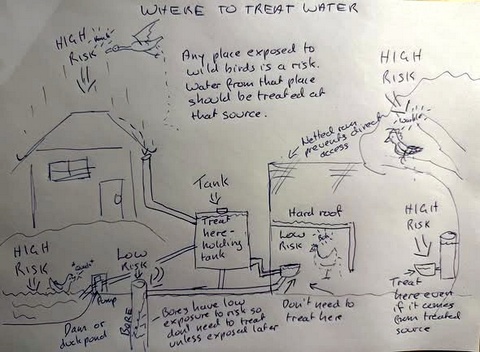
The key risk is wild birds - their droppings, feather dander, and any mucous from their eyes, beak, or nostrils. Reducing bird flu risk means reducing the ability of wild birds to access your poultry, their food, and their water.
Any point where wild bird droppings, dander, or mucous can enter your water supply is a risk.
Some things you can’t control. Open dams, rivers and creeks, or rainwater washing from your roof into tanks are outside your control, so don’t even worry about it.
Many things, you can. Poultry feeders and drinkers can (and should) be brought under hard cover. Runs can be netted to exclude wild birds, or placed under hard cover to exclude everything. Primary and holding tanks can be filtered and filled with treated water.
You can choose the right treatment method depending on the number of potential virus entry points.
When to treat?
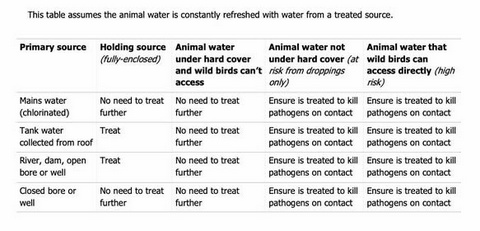
You need to treat water at the first point where wild birds can no longer access it.
The moment even one wild bird can potentially add even one dropping, feather dander, or mucous, to water that your animals may access, that water needs to be able to kill any pathogens near-instantly.
Chemical treatments and their residual levels should kill viruses within a minute. Copper containers may kill viruses within 6 hours. Other treatments don’t have residual levels and can’t kill viruses on contact.
What to treat with?
The bit everyone will skip to
Listed in alphabetical order.
Boiling water
Boiling water kills bird flu pathogens present in that batch immediately. If boiled and cooled water is added to sources that wild birds can access, it becomes a risk again and will need further treatment.
Water heating systems that operate between 60C and 70C will kill harmful bacteria. However, the water temperature at most outlets used in houses should be 50C or less. Test water temperature at outlets and if it’s over 60C, it may be suitable to use in animal drinking water once cooled.
Chlorine
This is the primary treatment in mains water. It should already have the correct residual levels to keep killing pathogens.
Chlorine kills bird flu pathogens present in that batch immediately. If maintained at the correct residual levels, it will continue to kill new pathogens on contact. This is 0.5 - 1ppm (0.5ml - 1ml per litre) residual free chlorine.
Do not use galvanised metal tanks for storing water treated with this chemical.
Test chlorine levels regularly, particularly after any activity that adds new, untreated water to your sources (eg rain topping up tanks or open water sources).
You can buy chlorine test strips from swimming pool shops and online; generally you get about 50 strips for about $30-$40.
Two helpful sites:
- NSW Department of Health: https://www.health.nsw.gov.au/.../water/Pages/rainwater.aspx
- Victoria Department of Health: https://www.health.vic.gov.au/water/cleaning#disinfecting
Both cover the use of powdered swimming pool chlorine (calcium hypochlorite, 65% available chlorine) and liquid chlorine (sodium hypochlorite, 12.5% available chlorine) for creating safe drinking water.
Domestic bleach is about 5% - 9% sodium hypochlorite. It can also be used to safely disinfect and maintain water.
The pages say that it takes “about 5 milligrams of chlorine per litre to disinfect your tank”, which translates to:
- 0.1 millilitres of domestic bleach per litre of water. Bleach must be plain and unscented, with between 5% and 9% sodium hypochlorite. Check the label before using.
- 7 grams of powdered calcium hypochlorite per 1000 litres of water (0.07 grams per litre)
- 40 millilitres of liquid 12.5% available chlorine sodium hypochlorite per 1000 litres of water (0.04 ml per litre).
Appropriate chemicals can be sourced from swimming pool shops. Discuss your requirements with them to perform the initial disinfection, and then to maintain residual free chlorine at 0.5-1.0ppm to ensure ongoing protection.
Many rural and produce stores will also stock chlorine-based water disinfection. Follow the directions on the containers to perform both the initial disinfection and then to maintain residual free chlorine at 0.5-1.0ppm.
Chlorine dioxide
This is different to plain chlorine. It is an effective water treatment that’s more potent than plain chlorine, is less-affected by organic mater (eg duck mud), and doesn’t have the chlorine aftertaste. It’s highly-recommended as a once-off treatment method for livestock water for that purpose.
Do not use galvanised metal tanks for storing water treated with this chemical.
Once-off treatments are quite easy, using compressed tablets found online and in camping/caravan stores. Use as per the instructions on the container.
You should maintain residual levels around 0.4mg/L (0.4ppm) - 0.8 mg/l (residual chlorine dioxide to keep killing viruses after initial treatment. This is more difficult to do without direct injection mechanisms. The tablets can’t do that at a reliable level.
Test strips can be bought online - look for “chlorine dioxide test strips”. You tend to get about 50 strips for about $50-$60.
Copper bowls
Yes, copper kills H5N1 viruses (and a range of bacteria) on contact.
However, it can take up to 6 hours for the viruses to be killed, and it will be less-effective on water that’s not in direct contact with the sides of a copper bowl.
It will not immediately kill any virus-laden droppings if they fall in a bowl, so is not a useful treatment method for water exposed to wild bird activity.
It is not recommended to store chemically-treated water in copper containers, as they may form their own reactions and risk copper toxicity.
It may be an effective secondary mechanism for water treated using filters or UV lights and kept under hard cover with no risk of wild bird exposure.
Copper-woven materials may be effective when used in filtration systems.
Filters and reverse osmosis systems
Standard water filters are NOT enough to remove or inactivate bird flu viruses from water.
You need “ultrafiltration (UF)” technologies, which use microscopic membrane pores (around 0.01 microns or smaller) to physically strain out viruses, achieving greater than a 3-to-4 log reduction of influenza particles.
There are a lot of filter and reverse osmosis systems on the market. If considering these for avian influenza management, discuss them with the supplier and ask them to provide a guarantee that they have been tested on viruses.
If they can’t provide that guarantee, use another method instead.
Hydrogen peroxide
You need a 35% food grade hydrogen peroxide product, not 3% strength supermarket ones. Source these at rural produce stores.
Do not use galvanised metal tanks for storing water treated with this chemical.
Products should have instructions for use on animal drinking water on the container. You’ll be looking at about 60 ml per 1,000 litres, or 0.06ml/litre.
You need a continuous residual concentration of 25 to 50 ppm (parts per million) of hydrogen peroxide for the water to keep killing the bird flu virus on contact.
Test strips can be bought online - look for “0–100 ppm hydrogen peroxide test strips”. You tend to get about 50 strips for about $60-$70.
Ozone
Ozone is extremely effective at killing H5N1. It needs residual concentrations of 0.5 to 1.0 mg/L with adequate contact time to keep killing viruses.
Do not use galvanised metal tanks for storing water treated with this chemical.
It requires on-site systems, which will cost between $500 and $7,000 and over, depending on the size of your system. Given the price, I’d assume they provide test methods so you can regularly check residual levels.
UV light
UV light is effective at killing bird flu viruses in the water that’s exposed to the UV.
However, it has no residual effect. UV treated water must be kept in enclosed systems and not be exposed to wild birds at all. If exposed, the water will need treatment in some other way to ensure no virus transmission to your poultry.
You can buy residential UV-C water sterilisation systems for between $500 and $2,500, depending on flow rate and size.
Virkon S
This will kill viruses, but is recommended for periodic system flushing, rather than continuous everyday use. Vets may recommend temporary use of Virkon S in drinking water to handle specific situations.
Things that do not work
DO NOT USE THESE TO TREAT POULTRY WATER AGAINST H5N1
Colloidal silver
No peer-reviewed evidence that it kills H5N1 has been demonstrated. Health authorities regularly warn against oral ingestion of colloidal silver due to health risks such as argyria and reducing absorption of other drugs such as antibiotics.
Potassium permanganate (Condy’s Crystals)
Not effective at levels that are safe to consume. Do not use.
Vinegar
While avian influenza viruses can be affected by acids, apple cider vinegar (or any other kind of vinegar) cannot be applied at a strong enough dilution that both kills the virus and allows the water to remain drinkable.
References
There were a lot. These are two key Australian ones. They're aimed at industry and can be quite heavy going.
The National Water Biosecurity Manual - Poultry Production: https://www.agriculture.gov.au/.../comm.../water_biosecurity.
Australian Drinking Water Guidelines: https://guidelines.nhmrc.gov.au/australian-drinking-water....
CDC - How to make water safe in an emergency. Has the domestic bleach dilution on it. https://www.cdc.gov/water-emergency/about/index.html
NSW Department of Health. This is aimed at ordinary people, not industry, and is very readable. https://www.health.nsw.gov.au/.../water/Pages/rainwater.aspx
Victoria Department of Health. This is aimed at ordinary people, not industry, and is very readable. https://www.health.vic.gov.au/water/cleaning#disinfecting