
When I first mentioned to Linda that I wanted to optimise the fridge and freezer to reduce their power usage, she said that she assumed that the settings as they came from the manufacturer would be what they needed. I think we all tend to think the same thing, if we think about it all. Certainly, I had never thought about it until I read Laura Trotta’s book ‘Sustainability in the Suburbs” (sound familiar?), in which she mentions the concept and how to go about it in general terms. I decided to investigate how to do it with our particular appliances, and this is what I found.
While fridges and freezers and freezers don’t run continuously, they do cycle on and off and can run for longer periods, especially if they are opened frequently. Due to this, if the temperature is set too low they can consume a considerable amount of electricity over time, adding more cost to your electricity bill.
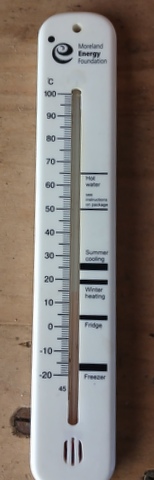
It is comparatively easy to measure the temperature of your fridge and freezer, all you need is a cheap and readily available home energy efficiency thermometer, we picked ours up many years ago as a freebie from a stall at a sustainability fair. Check the photo below. Quite often, they are part of a home energy efficiency kit, available to borrow for free from your local council through your library. Check with your council, if they don’t offer these, you can suggest that they should. The thermometers are also available cheaply online for as little as $10.
Fridge
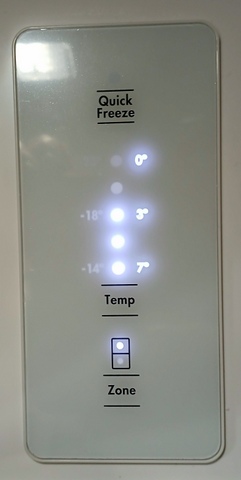
Fridge/freezer control panel
One of the things about fridges is that they can wind up being opened and closed quite often, to take stuff out, put it back or just to check what is on offer. This obviously can have an impact on the temperature inside the fridge. For short opening times, say, a few seconds to get a drink out, it can take the fridge 30 to 60 minutes to recover the temperature, longer (2 – 4 hours) when stacking the fridge with freshly bought (room temperature) groceries. The most accurate way I have found to check the fridge temperature is to leave the thermometer in a nice obvious place in the fridge and then leave the fridge unopened for a couple of hours, or even better, overnight. Slip the thermometer in just before you got to bed, then take it out and read it quickly when you get up. This will give you an accurate reading of what temperature your fridge is set to.
The temperature your fridge should be set between 1°C and 4°C
Our results for the fridge were:
Bottom shelf: 4°C
Top shelf: 4°C
Freezer
There are two types of freezers, chest freezers (horizontal) and upright freezers (vertical). As luck would have it, we have one of each, the chest freezer in the laundry room and the upright freezer attached to the bottom of the fridge. Cold air is denser than warm air and sinks, so it remains trapped in the bottom of a chest freezer when the lid is opened, whereas it spills out immediately when an upright freezer door is opened. The result is that the chest freezer will regain the low temperature more quickly than an upright. Due to this fact I used the thermometer in the fridge freezer in the same way as I used it with the fridge.
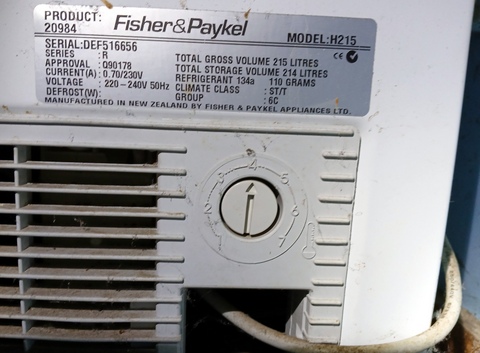
Another point to be considered when optimising your freezer is that food will be frozen regardless of whether the freezer is set at -18°C or -22°C, but the amount of electricity required to maintain the freezer at 22°C is somewhat more than to maintain it at -18°C. Generally, it is best to have the freezer set at -18°C. From what I have read some products, ice cream for example, can have quality issues if stored above -15°C.
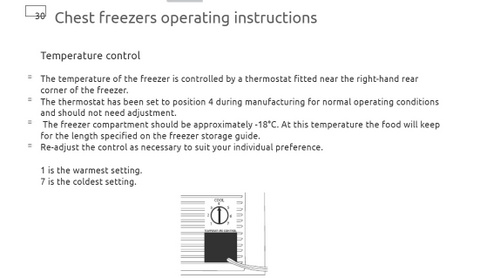
Our results for the freezers were:
Chest Freezer: -18°C
Fridge Freezer: -16°C
I found this to be an interesting exercise. We have had the chest freezer for over 15 years, and I was not even aware that adjusting the temperature was a thing, until I crawled in beside the RHS down near the floor and saw that there was in fact a method to adjust it! (see below). The fridge/freezer is another matter, being much more recently purchased we have the user manual that goes into considerable detail on how to adjust the temperature settings.
If anything, I may adjust the fridge freezer down a degree or two, but in general terms it is nice to know that our fridge and freezers are operating as they should and not consuming more energy than they need!