We put the system to take us more or less off grid in about ten years ago. It still works well for us but there has been some reduction it its capacity, due to some panel shading, increased demand and batteries requiring maintenance. A while back we had an outage overnight and the system was not able to maintain power, which concerned me for the fridge, and especially, the freezer. I decided I needed to build some resilience/redundancy into the system while working on some of the other system issues. This is what I came up with.
The Product
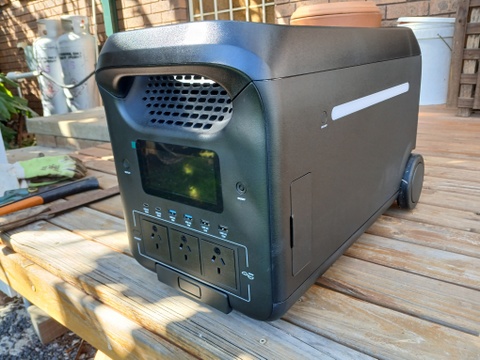
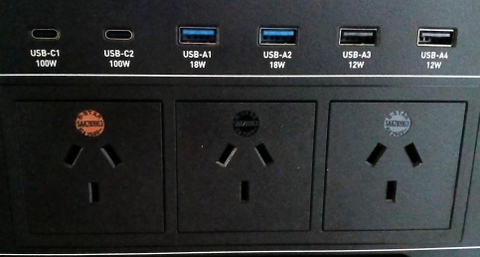
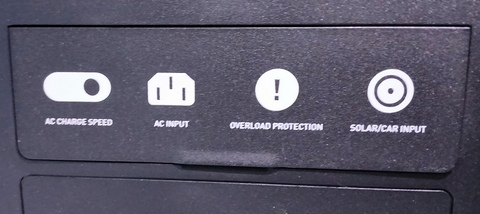
I wanted something that was portable, had a reasonable storage capacity and was easy to use, and after some research and tossing around ideas I decided on a 3000w portable power station (PPS) or solar power station (although there is no solar yet!) also called a KAPHUB 3000. It can be charged by the 240v system, 12v system or directly via solar panels. It has three 240v outlets, and 12v outlets include one mini Anderson, one cigarette socket, two USB-C, four USB-A and two DC5521 outputs.
The Set Up
My idea was to set the PPS up next to the freezer, connect it to the 240v power socket then plug the freezer into the PPS, and make use of its uninterruptable power supply (UPS) function. That would allow me to keep the PPS charged and if the power were to go out, it would connect to the PPS within 14 milliseconds (that’s what it says in the paperwork anyway!).
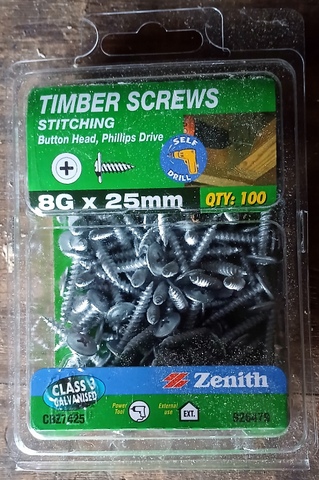
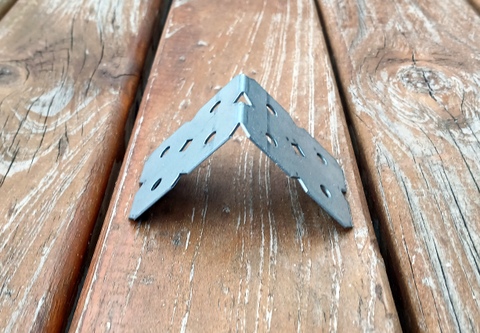
To do this I had to construct a small table to sit beside the freezer with sufficient clearance underneath to allow me to continue to store some of our bulk food buckets under it. I worked out that I had 40mm each side for the table structure and could still fit the buckets in, so I bought some lengths of 30mm x 40mm pine and a piece of 12mm OSB Particleboard. To hold everything together I bought some 50mm x 50mm x 40mm x 1mm thick angles, to be secured using 8 gauge x 25mm long stitching timber screws.
I set out to construct it as shown in the photos below. Once it was completed, I decided to fit it into place and see how it worked. The width measurement that I had taken was between the freezer and the wall, which showed the width of the PPS plus 40mm on each side, so that is how I built it! Of course, this did not allow for the 15mm x 40mm skirting board at the base of the wall (D’OH!). I had to remove the two right hand legs and using the band saw, remove a cut out to allow the leg to fit within the space effectively.
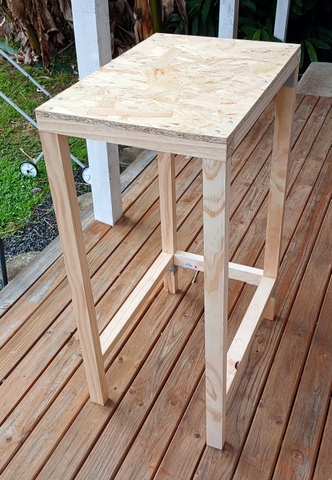
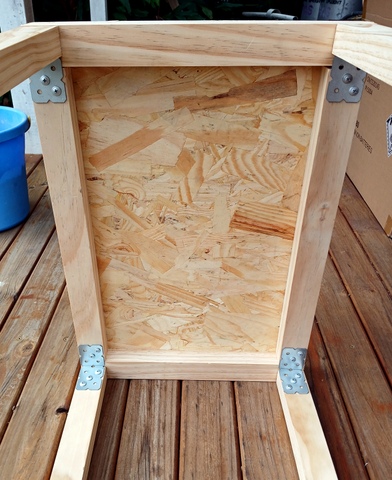
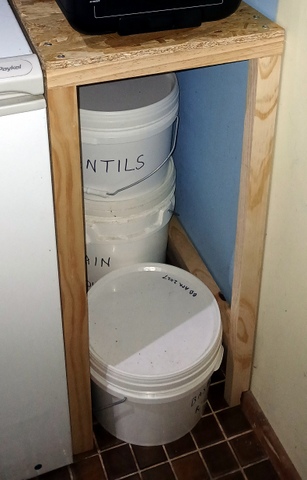
With the table finished and in place I lifted the PPS and put it on top of the table so it was ready to go. The idea was to charge it up (it was reading about 60% at that point), plug in the freezer and see how long it would power the freezer for.
Our current set up is such that power comes from the solar panels down to the batteries through the MPPT, it is then directed from the batteries up through the Victron 3000w sine wave inverter and into the house. If there is a situation where there is more power drawn than the batteries can provide (due to poor charging because of cloudy weather, too many appliances switched on or whatever) it switches back to the grid (mostly) automatically.
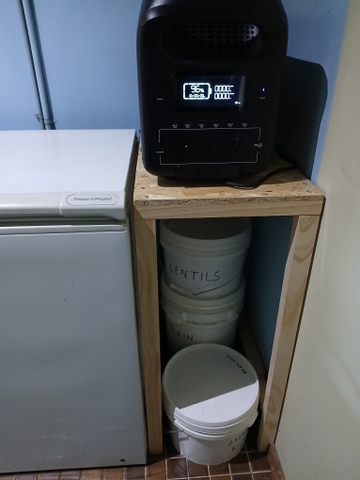
When I plugged the PPS in to the 240v socket to charge, all it did was flicker, click on and off and swear at me! Not sure what was going on I switched the system back onto the grid manually and everything was then OK. I charged the PPS up to 100% then disconnected it from the power and plugged the freezer into it, to see how long it would last. Hopefully it could keep the freezer running overnight and maybe the fridge too.
The charge on the PPS dropped from 98% to 35% in 24 hours, so the overnight freezer thing was not a problem, working on the idea that it would recharge from the system during the day.
The Problem
Ahh, about that!
Every time I tried to charge from my off-grid system, all the PPS would do was flicker and swear at me. I contacted the manufacturer and, after considerable discussion, they could offer no real insight into the problem, so I did a bit of my own online research and came up with some surprising information on why the PPS and the inverter may not talk to each other:
- Inverter Overload: If you have a Victron inverter smaller than 2000W–3000W (such as a 1200VA or 1600VA model), or if a 3000VA Victron unit is already running other loads, the massive surge and draw of the PPS unit will trigger the Victron's overload protection and shut down the AC output. (Makes sense but I do not believe it is the issue in this case)
- Input Current Limit: Victron inverters (like the MultiPlus range) have a programmable AC input current limit (PowerControl). If the Victron is set to a low amp limit (e.g., 10A or 16A) to protect a generator or a small circuit breaker, it will restrict the amount of AC power it passes through, starving the PPS unit or causing the Victron to reject the charge cycle.
- Waveform / Frequency Mismatch: While Victron units output clean pure sine wave power, an improperly configured frequency (e.g., 50Hz vs 60Hz settings in the Victron VE.Bus configuration) or strict input tolerance settings can cause the power station's internal AC charger to reject the inverter's AC output.
- Wrong Battery configuration: the Victron is configured for nickel iron batteries, not LiFePO4 batteries like those in the PPS.
- Mismatch in the electronics between the PPS battery management system and the inverter.
Whichever is the problem my inverter and the PPS steadfastly refuse to talk to each other!
An Answer
The research did hold out a bit of hope in that I can charge the PPS using DC output from the batteries to the 12v charging port in the PPS but for the time being at least I will be charging the PPS up to 100% weekly using the grid so that if we have a power outage, I can connect the freezer up to the PPS manually, which will only take a few minutes anyway.
Alternative Charging
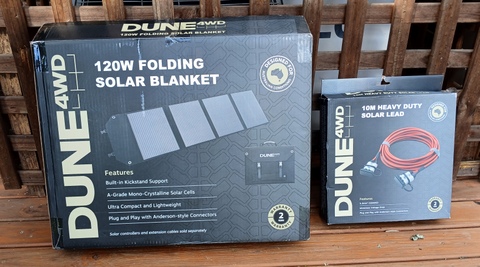
To make sure I got the best out of the new PPS I wound up getting a ‘solar blanket’ or set of portable solar panels that were sewn together so that they could be folded up into something that looked like a briefcase. Along with the solar panel set up I got a 10 metre solar lead so that I could leave the PPS beside the freezer in the laundry and connect it to the solar panels arranged in the sun in the backyard.
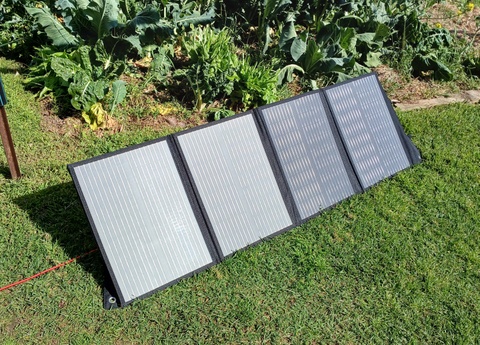
What this has done is to give me small solar system that is independent from the main household system and is, should I ever need it to be, portable. Thus, it provides some redundancy and resilience for our household electrical power systems.